Helping Others Find ‘Stability, Dignity, Healing & Hope’: Sr. Mary Bader, DC, Honored with Saint Luke Award
Posted on: October 20, 2026
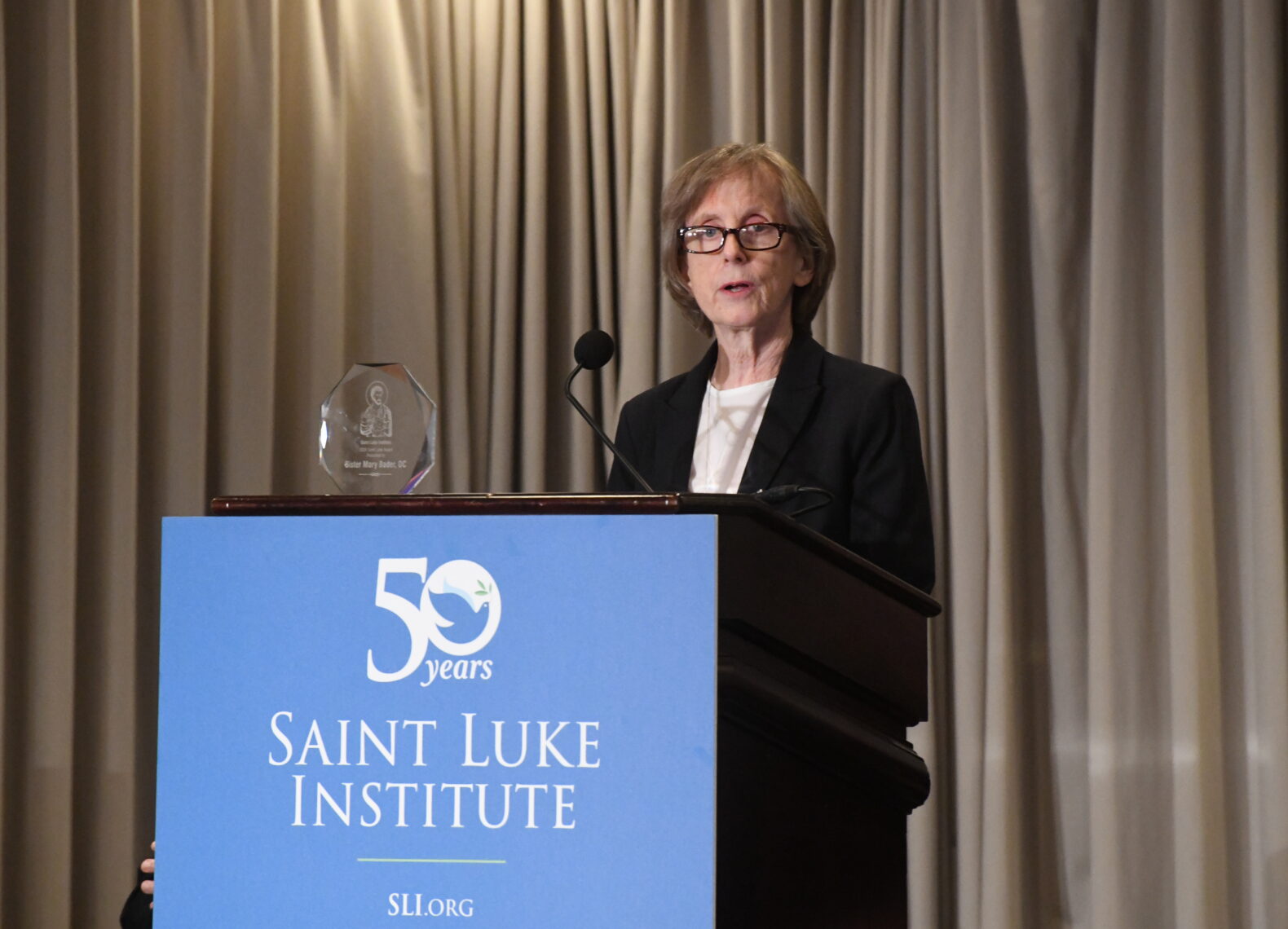
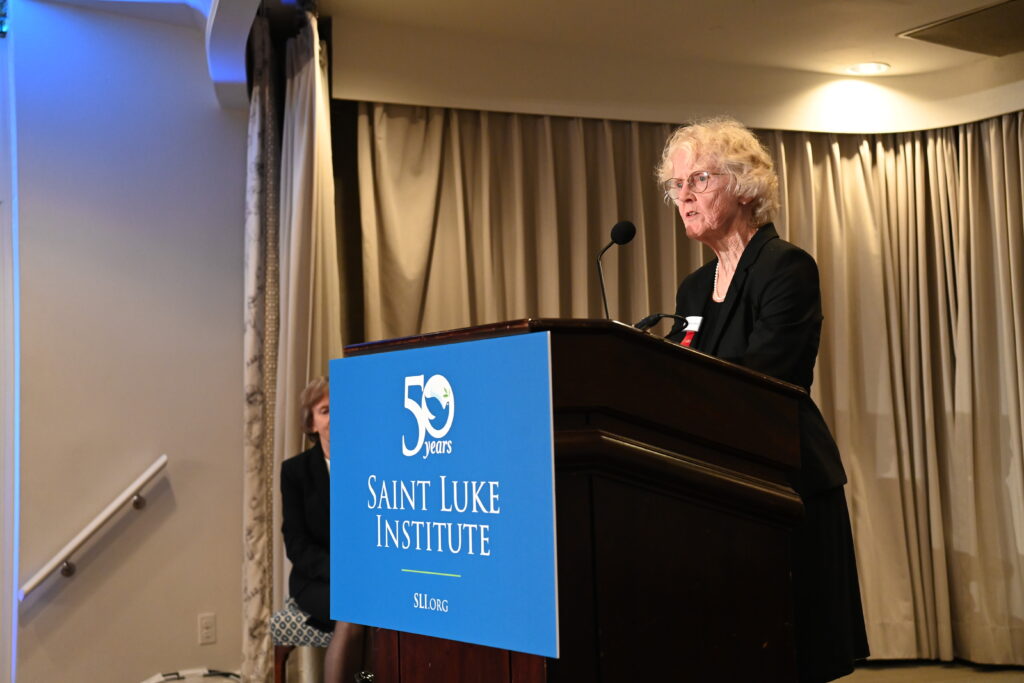
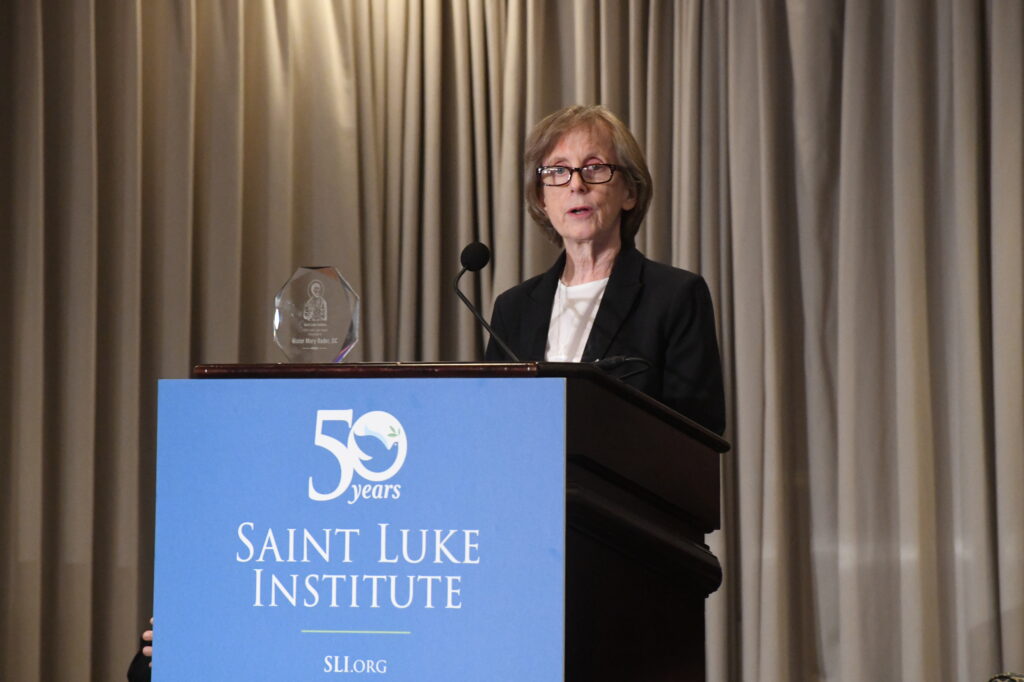
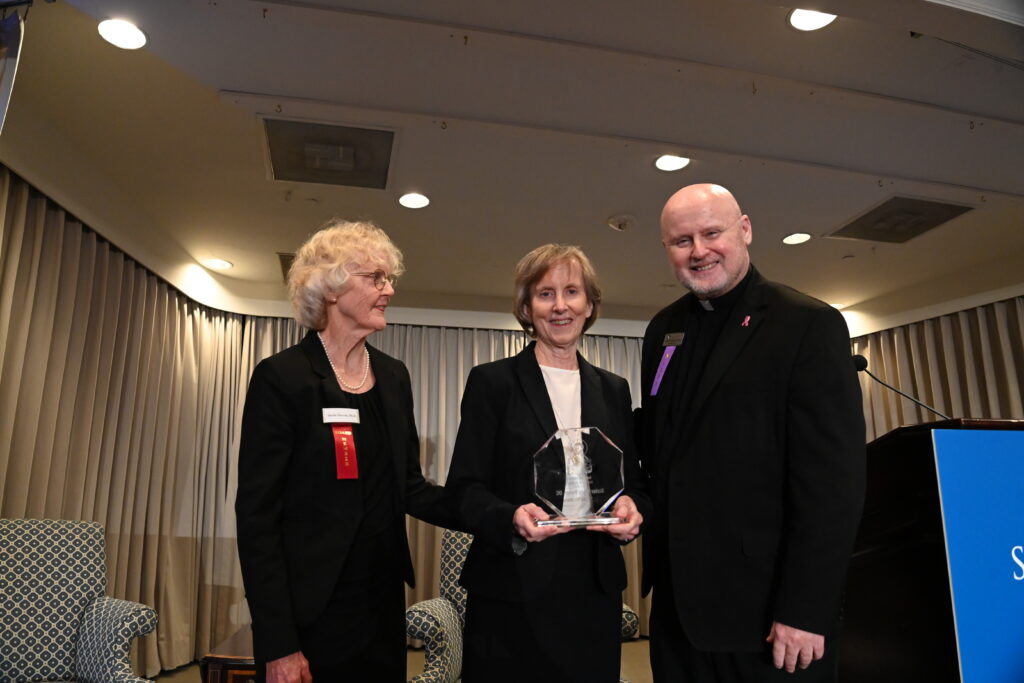
At the Saint Luke Institute (SLI) 2026 October Benefit, we were pleased to honor Sr. Mary Bader, DC, former Chief Executive Officer at St. Ann’s Center for Children, Youth, and Families in Hyattsville, Maryland – a role she served in for nearly 20 years, from 2005 to 2023. Below are the remarks from Sheila Harron, PhD, SLI Board Member, introducing Sr. Bader, as well as Sr. Bader’s remarks from the event at which she received the Saint Luke Award.
Introduction of the 2026 Saint Luke Award Recipient
Sheila Harron, PhD
Good evening. It is my great pleasure to introduce this year’s Saint Luke Award honoree, a woman whose life and ministry reflect the very best of compassionate leadership, faithful service and care for the most vulnerable among us: Sister Mary Bader, Daughter of Charity.
The Saint Luke Award recognizes individuals whose lives embody healing, hope and commitment to human dignity. Sister Mary is an extraordinary recipient because she has dedicated her entire vocation to those values, serving vulnerable children, women and families with remarkable vision, humility and love.
A native of Washington, D.C., Sister Mary has spent more than three decades as a Daughter of Charity, living the Vincentian mission of serving people who are poor and marginalized. Throughout her ministry, she has been an educator, principal, leader, mentor and advocate. But regardless of the role she held, her focus has always been the same: recognizing the dignity of every person and creating opportunities for others to thrive.
For nearly twenty years, Sister Mary has served as Chief Executive Officer of St. Ann’s Center for Children, Youth and Families in Hyattsville, Maryland. Under her leadership, St. Ann’s evolved to meet changing community needs, expanding its support for mothers and children experiencing homelessness and other serious challenges. Guided by the Vincentian call to be “creative to infinity,” she helped transform the organization’s services while remaining firmly rooted in the mission of compassion and care.
Sister Mary’s leadership has extended well beyond St. Ann’s. She has generously shared her gifts through service on numerous boards and committees supporting health care, education, housing and social services. Her influence has been felt across the area and throughout the Church.
What makes Sister Mary a particularly fitting recipient of the Saint Luke Award, however, is her deep appreciation of the importance of mental health and spiritual well-being. Throughout her years of ministry, she has witnessed how healing and support can transform lives. She has also recognized the critical need to care for those who themselves care for others.
In speaking about Saint Luke Institute, Sister Mary described its work as “healing the healers and caring for the caregivers.” She understands that the health of religious women and men, clergy and Church ministers directly impacts the communities they serve. Her support for Saint Luke’s mission is a living example that reflects her ongoing commitment to ensuring that compassion, healing and hope remain available to all.
Tonight, we honor not only an accomplished leader, but a woman of deep faith whose life has touched countless individuals and families. Through her leadership, service and witness, Sister Mary has helped many others find stability, dignity, healing and hope.
Please join me in congratulating and welcoming the recipient of the 2026 Saint Luke Award, Sister Mary Bader, Daughter of Charity. [applause]
Acceptance Remarks, 2026 Saint Luke Award Recipient
Sr. Mary Bader, DC
I am very, very honored to be acknowledged, but I am probably more humbled to be with you tonight to support the mission of Saint Luke’s. And as we’ve heard, much of what I was going to say tonight has already been shared by John [ Dombrowski, MD, Master of Ceremonies]. All right, John—I read your notes, and that’s what happened here. You see, I looked over your paper here. Oh, darn it. [laughter]
Well, anyway, at the risk of sounding repetitive, I will still continue on. But I truly am very, very humbled to be here tonight and to be able to help in the mission, this very vital mission, of Saint Luke Institute. As we’ve heard, it is a program that heals and transforms lives—the lives of men and women religious, priests and deacons, as well as, I think, members of other religious denominations.
But if we look beyond those titles of Father and Bishop and Sister, we see men and women who are caregivers, who are ministers, healers, advocates—people who are about the world tending the flocks in parishes, advocating on behalf of others, ministering in classrooms and social service agencies, hospitals, clinics, prisons, seminaries, on college campuses, abroad, sometimes in very remote areas of the world, sometimes in challenging parts of the world or of our country. They serve vulnerable populations: the homeless, immigrants, the sick and the incarcerated. And I shouldn’t keep saying “they”—we. We serve vulnerable populations: the homeless, immigrants, the sick and the incarcerated. And they serve and minister to the comfortable. They are about the mission of ministering, healing and transforming others’ lives; bringing the love of God to all; spreading the faith; and building the Kingdom. Building the Kingdom.
And sometimes, as we’ve heard, these ministers, healers and caregivers need a little bit of healing themselves. They need the help of a program like Saint Luke’s to guide, support, lift up, recharge, renew—and in some cases bring back to life—these individuals. But we don’t expect our ministers, do we, to have such needs. Yet no one, including all of us, is exempt from the human condition. It just doesn’t happen that way.
Fortunately, for over fifty years here at Saint Luke’s, we have seen a resource provided to the Church serving the healing of our ministers. Though I haven’t personally benefited from Saint Luke’s services, I have known men and women of the Church who have experienced that healthy growth, that transformation, through the gift of what Saint Luke’s offers. I could spend so much time tonight talking about the specific programs, the holistic approach to strengthening body, mind and spirit, the different treatment modalities, and the compassionate and skilled clinicians. But there is another facet of the program that I think enriches it, and I am going to turn to a parable.
Cardinal McElroy, a few weeks ago you gave a wonderful homily at the immigration Mass—[applause]—a beautiful homily on the Good Samaritan. I am going to use that same parable in my reflection here. I certainly won’t do justice to what you did, but in a different context I’ll offer a little different perspective.
I think we all know the story. The Samaritan approaches the injured man, dresses his wounds, pours wine and oil on his body, lifts him up onto his beast, walks beside him and takes him to an inn, where he cares for him himself. And he pays another, the innkeeper, to care for him while he steps away and takes care of business. He assures the injured man that he will return—and he does return.
Among the themes of this parable is the story of accompaniment. Accompaniment: the Samaritan accompanying the man on the journey to wholeness, acknowledging his humanity and affording him his dignity, tending to his injuries, walking beside him as he rested on the donkey, bringing the man to a safe place and caring for him, leaving the man in the care of another person—and then he returns and checks on him. This is accompaniment, and this is one of the keys to Saint Luke’s success in bringing people back to a different place in their lives. It is the accompaniment. [applause]
It is offering unconditional love and compassion, a steady hand of support, and a holistic program that focuses on the whole being—body, mind and spirit—walking with them through every stage of the healing journey, guided by the skilled clinicians we’ve heard of: the medical staff, the therapists, the spiritual directors and the support staff. This is the accompaniment that is experienced through Saint Luke’s, and I have seen it in some of the brothers and sisters I have known who have been part of the program.
When we think about the ministry of the Church, of all of us in the Church, it is the ministry of accompanying—whether it is a pastor comforting a grieving family on the loss of a loved one, a sister in campus ministry accompanying young people on a service project, or a sister bringing Communion to the residents of a nursing home, accompanying them on the latter part of their journey. I don’t know if the practice of accompaniment is what we would call a treatment modality—maybe Sister Salvatrice knows that. But I think it truly is fair to say that much of the lived mission of our Church, in its ministries and at Saint Luke’s, is that of accompaniment. And sometimes those who accompany others need the accompaniment themselves.
In my years at St. Ann’s, here in the Archdiocese, I came to understand and appreciate that spirit of accompaniment, that need for accompaniment, in working with the children and the mothers entrusted to our care, who had been placed with St. Ann’s because of abuse, neglect and sometimes other reasons.
I think often of a twelve-year-old girl, Brenda, a foster child placed at St. Ann’s for reasons of neglect and abuse in her life. For nearly a year she stayed in our program before being placed in a traditional foster home out in the community. Months after leaving St. Ann’s and being placed in that home, she unexpectedly showed up at St. Ann’s door, telling us she had come for a visit. It soon became apparent in our conversation that she had run away from her foster home. After she acknowledged being AWOL, I asked her, “Why did you come back, Brenda? Why did you come to St. Ann’s?” And her response was this: “Y’all loved me.” Y’all loved me. That’s what it was. [Applause]
And then she talked about Miss Ola. “Miss Ola did my hair nicely.” Miss Ola was a child care staff member. And Mr. Forbes, who drove the school bus, taking her and the other kids to school and picking them up. She said, “Mr. Forbes picked me up from school, but he wouldn’t let me get on the bus until I told him something good about school.” “Miss Ilka kept our rooms clean even when we messed them up.” And “Miss Melissa let me stay up late at night to watch TV if I didn’t act up.”
That was her version, her vision, her experience of accompaniment: caring for Brenda, respecting her, teaching her, encouraging her to bring forth her gifts, and letting her know that she is loved and made in the image and likeness of God. And our Church ministers, who have been the Good Samaritan to others, at times need Saint Luke’s to walk with them on the journey to wholeness, just like Brenda. And as the health and well-being of individual religious and clergy is restored, the health of the Church is made stronger.
So I thank you for this honor, and know that I share it with each of you, because Saint Luke’s does not happen without others accompanying the mission. I thank the staff and the board of Saint Luke’s, and the many Good Samaritans who are here tonight, whose every gesture is building the Kingdom of God and building a healthier Church for us. Thank you very much. [applause]
+ + +
Read more details about the Benefit.
Images:
Sheila Harron, PhD, introduces Sr. Mary Bader, DC; Sr. Mary Bader, makes her remarks; Dr. Harron and Sr. Bader pose with SLI President & CEO Rev. Patrick J. McDevitt, CM, PhD following Sr. Bader’s remarks
Photos
Images from the Saint Luke Award Presentation